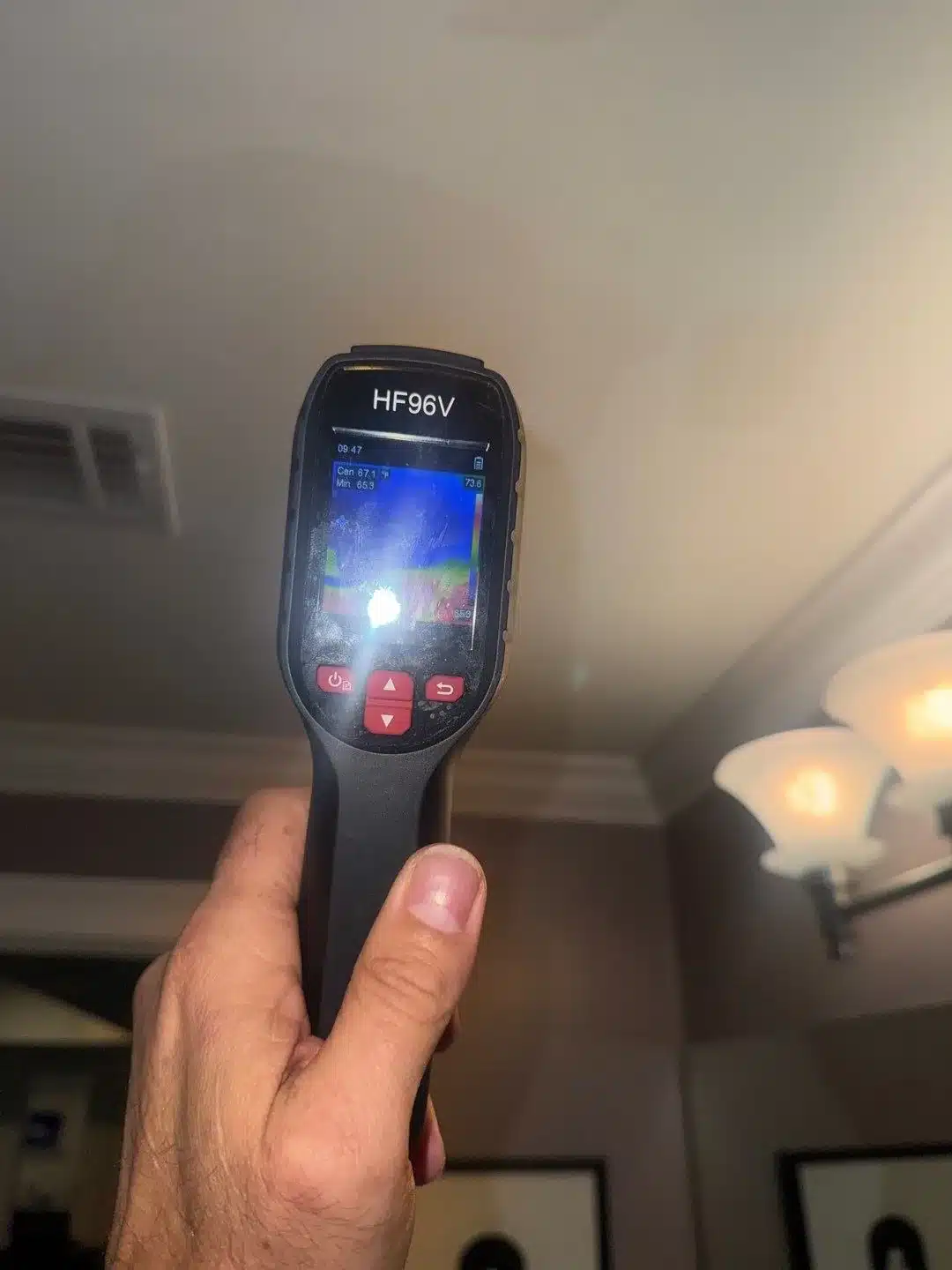
Handheld HF96V thermal imaging camera displaying a colorful heat map and temperature readings, with red control buttons.

Thermal Imaging for Water Damage: What Needs Verification

A temperature pattern can point toward hidden moisture. Meter readings help establish whether that pattern represents wet material before drying or removal decisions are made.

Talk to our team

Thermal imaging can reveal surface temperature patterns that suggest where hidden water damage needs closer investigation. It cannot prove moisture by itself; meter readings and an assessment of the affected materials should guide decisions about drying or removal.

At One Stop Restoration, we use infrared assessment, pin and pinless metering, and moisture maps. Each serves a different purpose: locating a suspected area, checking the material, and showing where moisture findings extend.

What can thermal imaging reveal about water damage?

Thermal imaging identifies temperature differences across visible surfaces. Those differences can help narrow where to investigate a ceiling, wall, or floor without treating every discolored area as the full extent of the problem.

Wet material can have a different surface temperature from nearby dry material. Evaporation can cool a surface, for example. A camera can make that contrast easier to recognize, including where there is no obvious stain.

The useful finding is an area worth checking, not a confirmed outline of water damage. A scan helps direct moisture testing. It does not establish how much material is wet or whether the layers behind the surface are affected.

Why isn’t a thermal image proof of moisture?

A thermal camera detects surface temperature differences, not water itself. Its colorful display and temperature readings do not measure moisture content.

Air movement, insulation differences, sunlight, and nearby heat sources can also create contrasting patterns. A cool patch might warrant moisture testing, but its color alone cannot identify the cause. The camera also does not see through drywall to show the contents of a wall cavity.

The reverse matters too: wet material may not produce a clear temperature contrast. An unremarkable scan does not establish that an assembly is dry. If a known leak or other evidence points to water intrusion, the investigation should not stop because the screen looks uniform.

What should be used to verify a suspected wet area?

Moisture-meter testing should check the suspected material, while a moisture map records where the findings occur. We use these methods alongside infrared assessment; they provide different kinds of information rather than interchangeable pictures of the same thing.

  • Pin metering: Pins contact the material and measure electrical resistance. The reading needs interpretation for the material and meter settings. It checks the tested location, not every layer of the assembly.
  • Pinless metering: A sensor checks material without inserting pins. It can help compare areas, but material density, metal, and the meter’s sensing depth can affect the result.
  • Moisture mapping: Readings are tied to their locations to show the pattern of confirmed findings. A map distinguishes tested areas from places that remain inaccessible or unverified.

Can a scan decide demolition, cost, or timing?

A thermal scan alone should not decide removal scope, price, or schedule. Those decisions need confirmed moisture findings and an assessment of the material’s condition, contamination, and ability to dry.

A temperature pattern does not show whether drywall has lost strength, whether insulation is wet, or whether a concealed layer can be dried without opening the assembly. Ask what finding supports each proposed removal and what remains uncertain. Our guide to wet drywall removal addresses the separate question of what can stay and what may need to go.

Cost depends on the affected area, the materials involved, access to trapped moisture, drying equipment needs, and any necessary removal and rebuilding. Timing also depends on whether wetting has stopped and how the materials respond to drying.

Before painted surfaces are disturbed in covered pre-1978 housing or child-occupied facilities, Georgia’s lead renovation requirements require applicable certified renovation firm and renovator credentials. Georgia administers an authorized program under the federal EPA lead renovation framework. Emergency restoration is not a blanket waiver of these duties.

If the scope extends into regulated reconstruction, Georgia contractor licensing requirements apply subject to the work’s scope and exemptions. Confirm permit requirements with the authority responsible for the property before rebuilding.

What should you do during an active water loss?

Arrange moisture verification rather than waiting for a thermal image to settle the diagnosis. Stay out of standing water where electrical hazards may be present, and do not cut into a wall or ceiling based on a camera display.

When you call, describe where water is appearing, whether it is still entering, and which rooms or surfaces are affected. These observations help explain the problem without assuming that the visible stain marks the source.

We offer moisture detection and water damage restoration, with 24/7 emergency availability, including holidays, and local live answering. Availability does not establish an arrival time.

Frequently asked questions

Can thermal imaging identify the exact source of a leak?

Not reliably by itself. Water can travel along framing or other surfaces before it becomes visible, so the temperature pattern may be away from the entry point. Tell us when the symptom appears and whether it changes with rain or fixture use; those observations can help guide the investigation.

Can a thermal scan confirm that a wall is dry after water removal?

No. Removing standing water does not establish that the wall’s materials have dried. Follow-up moisture readings need to be interpreted for the material and compared with an appropriate dry reference. Ask which layers were checked, especially if the wall includes insulation or other concealed materials.

Does a thermal image prove that damaged material must be removed?

No. If removal is recommended, ask for the reason tied to that material: loss of integrity, contamination, or an inability to reach and dry affected layers. Also ask whether the proposed opening is for investigation or permanent removal, since those are different decisions with different purposes.

Will an insurer accept thermal images without moisture-meter readings?

That depends on the insurer’s requirements for the particular claim. Ask the claim representative what supporting evidence is needed rather than assuming a thermal image will be sufficient. Acceptance of an image as documentation is also separate from a decision about coverage or payment for the proposed work.

Dealing with water, fire or mold right now?

Tell us what you are seeing and where. We scope the damage from instrument readings before anything is opened, and document it for your insurer from the first hour.